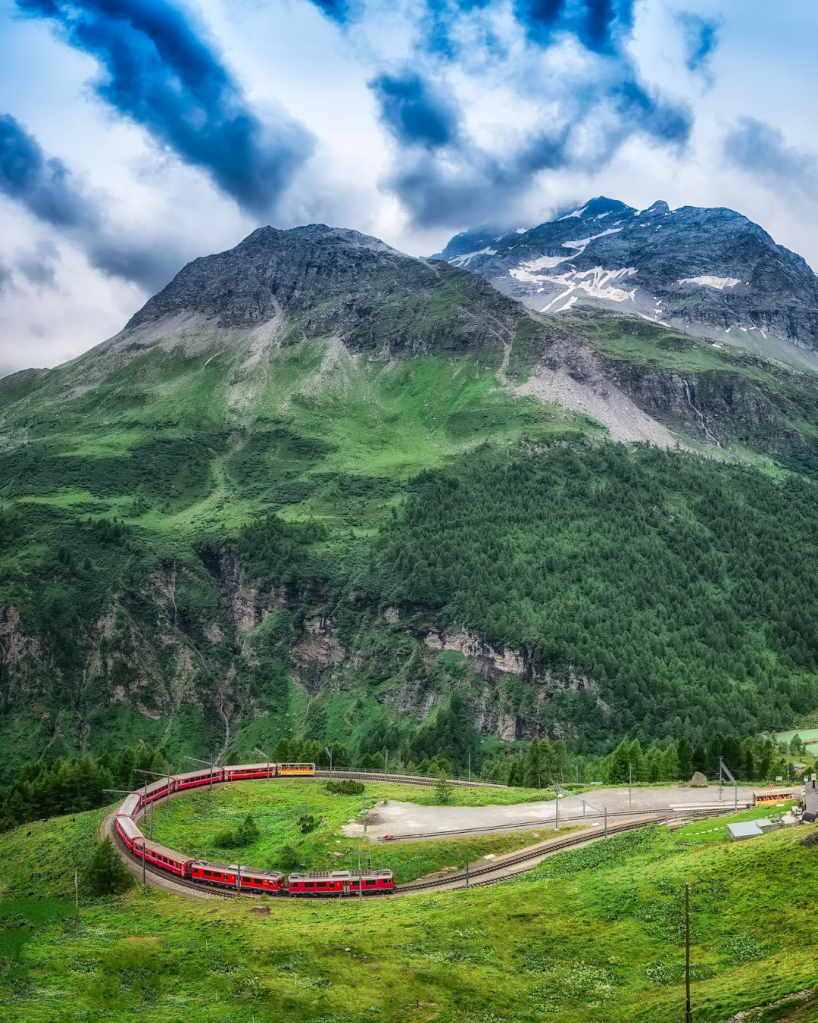
Imagine beginning your day surrounded by snow-capped glaciers and ending it under swaying palm trees with a scoop of gelato in hand. That, in a nutshell, is the magic of the Bernina Express. This legendary train ride traverses the Swiss Alps from Chur (or St. Moritz) to Tirano, Italy, whisking you through UNESCO World Heritage landscapes and over engineering marvels more than a century old. Part travel guide, part personal journey, this article invites you aboard the slow-rolling Bernina Express – a train so scenic and serene that “express” feels like a delightful inside joke. So grab a window seat (on the right side, trust me) and prepare for a ride where every turn is a postcard and even the train’s unhurried pace becomes part of the charm.
A Panorama of Alpine Highlights
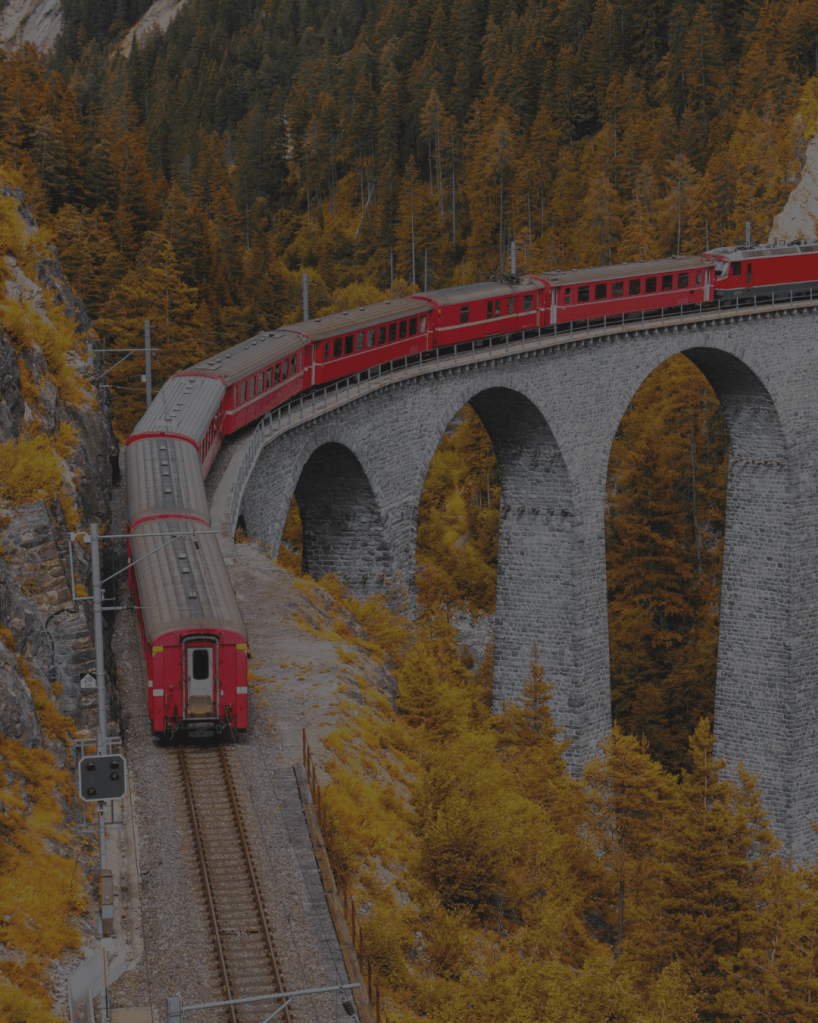
A bright red Swiss train (sibling to the Bernina Express) gracefully curves over the Landwasser Viaduct, a 65-meter-high limestone bridge that seems to defy gravity. Crossing this iconic viaduct is an early highlight of the journey . As the Bernina Express glides onto the Landwasser Viaduct – its five stone arches leaping out from a sheer cliff – you’ll feel your jaw drop along with the valley floor below. I press my face to the panoramic window, simultaneously awe-struck and trying not to drool on the glass. This single-track bridge, opened in 1902, remains an emblem of the Rhaetian Railway’s audacity. The train slows (not that it was ever fast) to afford a lingering gaze; after all, who would want to rush across a UNESCO-listed masterpiece? The moment we plunge from the viaduct straight into a tunnel carved in the cliffside, the entire car whooshes with a collective exhale – did that just happen? Yes, and it’s only the beginning.
Emerging from tunnels (there are 55 of them in total on this route ), the train winds through lush pine forests and storybook villages. Each bend reveals a new surprise – perhaps a waterfall cascading down a crag, or a herd of content Swiss cows munching away as if oblivious to the world’s most scenic train passing by. (One cow near Filisur looked up nonchalantly, almost as if to say, “Oh, you’re back? Moo-ving along then.”) Onboard, cameras and smartphones swivel from side to side, and occasionally you’ll hear a thud as someone literally bounces between windows in giddy pursuit of the next photo. Through it all, the Bernina Express maintains a leisurely pace – around 30 mph at most – which is perfect. It’s a train that savors the scenery rather than blurs it. As a passenger, you learn to do the same, slowing down your travel mindset to alpine time.
Climbing to the Bernina Pass – High Altitude Drama
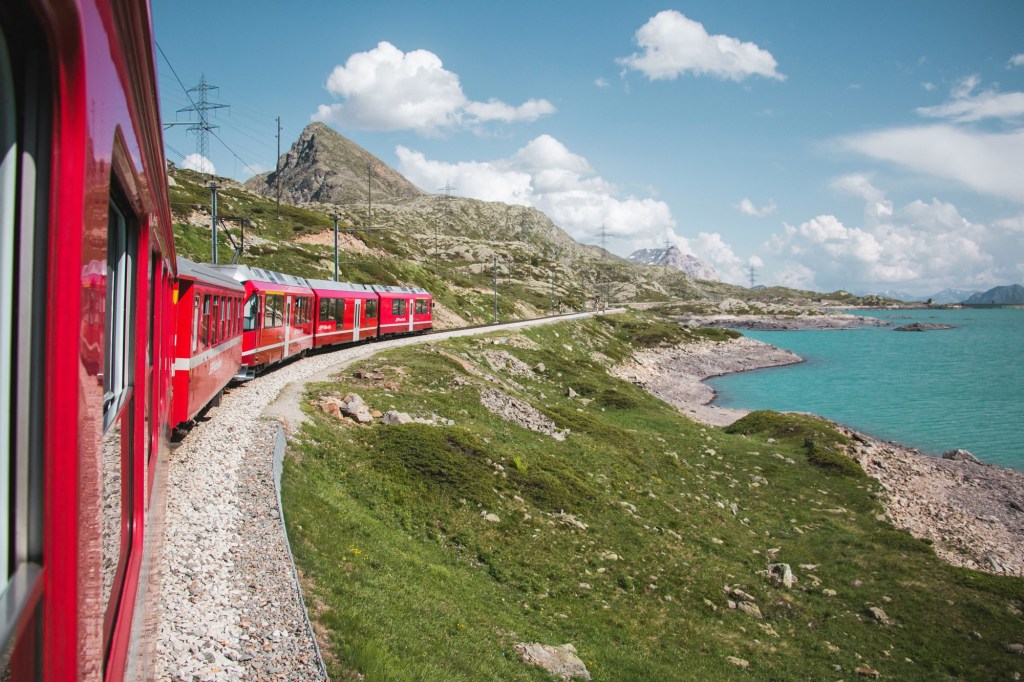
As we snake higher into the mountains, the air grows crisper and the terrain more rugged. The train crests the Bernina Pass at over 2,250 meters (7,400 ft) above sea level – officially the highest transalpine railway crossing in Europe . Up here, the landscape is otherworldly. The Bernina Express chugs beside the glacier-fed Lago Bianco, a milky turquoise lake that mirrors the sky when calm. On clear days, jagged peaks and icy glaciers like Morteratsch and Palü loom in the distance, glittering under the sun. I step into the vestibule between cars to snap a photo minus the window glare – a pro tip for photographers – and nearly drop my phone when confronted with the view. There’s snow on the mountains and ice on the lake, yet I’m comfortably warm behind the glass, nose pressed against it like an excited kid at a candy store.
Crossing the Bernina Pass isn’t just a visual thrill; it’s a testament to ingenious railway engineering. This line was completed in 1910 with no cogwheel assistance, despite the steep gradients. In fact, the Bernina line remains one of the steepest adhesion railways (no toothed rack rails, just wheel friction) in the world . As the train eases over the summit, you might notice the grinning conductor – perhaps because gravity will do some work from here on, or perhaps because he knows the best part is yet to come. The brief stop at Alp Grüm station (if the schedule allows) offers a chance to stretch your legs and gasp at the panorama of the Palü Glacier dropping into the valley. Don’t stray too far – the train won’t leave without you, but you will want to be on it for what comes next.
Spiraling Down to Italy – From Alpines to Aperitifs

An aerial view of the Brusio Circular Viaduct, where the Bernina train loops over itself to cleverly navigate a steep drop in elevation. As we approach Brusio, excitement in the carriage builds – even the previously sedate couple across from me perk up, cameras at the ready. “Here it comes!” someone chirps. The red train then enters the 360° spiral, curling over itself on a 9-arched viaduct that circles a green meadow . Through the window, I can hilariously see the front of our train below us curving in the opposite direction – a true “is this real?” moment. This engineering marvel, opened in 1908, keeps the gradient at a mere 7% so the train can safely lose altitude without turning us into a literal rollercoaster.
Pro tip: Sit on the right-hand side when heading south to Tirano for the best views of the Brusio loop and to wave cheekily at fellow passengers across the circle . By the time we straighten out, we’ve dropped about 30 meters in elevation, and possibly left our sense of direction back on that loop!
From here, Switzerland’s Val Poschiavo opens up with its vineyards and chestnut trees, an early hint of the Italian climate ahead. The train makes its final descent through quaint villages – each with a charming little station where locals may wave at the passing train – and then, almost suddenly, we roll into Tirano, Italy. You’ll know you’ve arrived not just because the conductor cheerily announces “Tirano” in multiple languages, but because the scenery has done a dramatic costume change. The alpine firs have given way to swaying palms, the cool mountain air replaced by balmy warmth. One minute you’re gazing at glaciers; the next, you’re steps from Italian cafés serving espresso and gelato. And yes, the rumors are true: you can literally walk across the street from Tirano station and reward yourself with a scoop of gelato or a slice of pizza. After four hours of alpine adventure, your taste buds will think they traveled to a whole new world – because they did.
Rails Rich in History and Heritage
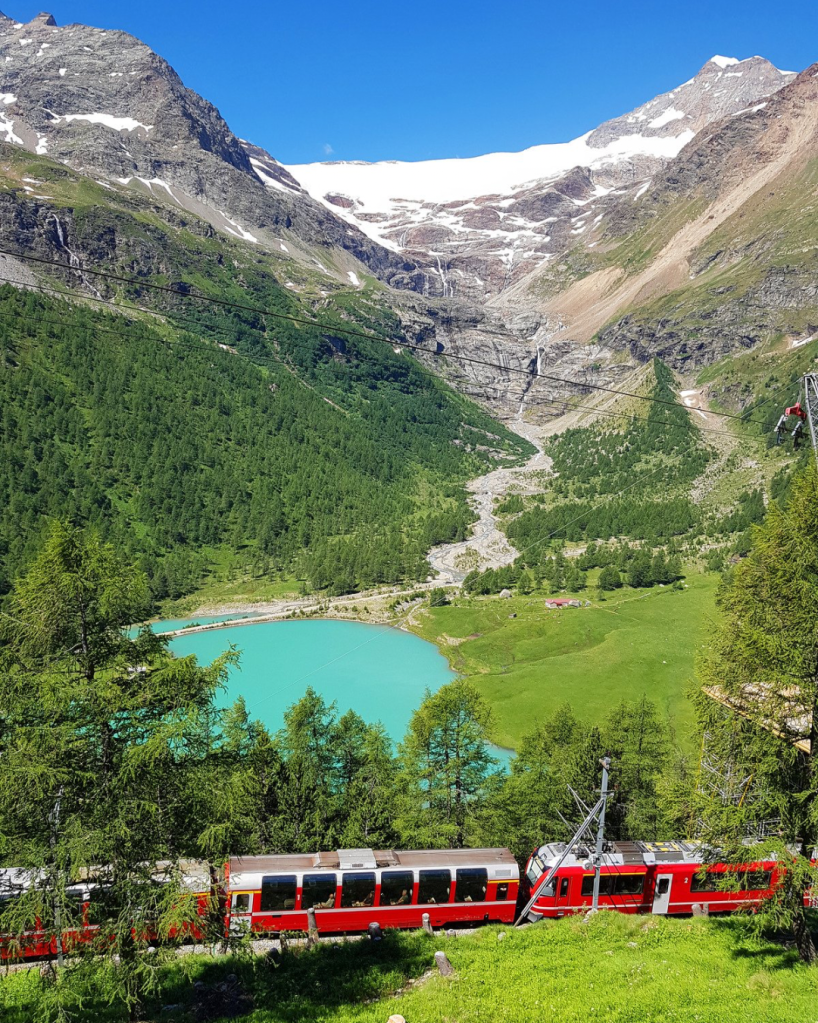
Part of what makes the Bernina Express so special is the history humming along these tracks. The route is operated by the Rhaetian Railway (RhB), which began carving narrow-gauge lines into these mountains over 120 years ago. The Bernina line itself – from St. Moritz to Tirano – was completed in 1910 as a bold extension connecting Switzerland to Italy . Meanwhile, the northern Albula line (Chur to St. Moritz, which our train also traverses) opened in 1904, astonishing the world with its tunnels and lofty bridges. Together, the Albula and Bernina lines were recognized in 2008 by UNESCO for their outstanding engineering and harmony with the landscape . Riding the Bernina Express, you are literally traveling through a World Heritage Site, where every viaduct and every helical tunnel was designed not just to conquer the Alps, but to showcase them.
It’s humbling to think that the Landwasser Viaduct, the Brusio spiral, and all those hand-hewn tunnels were created with early 20th-century technology – no drones, no laser cutters, just grit, dynamite, and a vision. And they’ve stood the test of time. Over a century later, these tracks still carry daily trains and delight travelers from around the globe. In summer you might find yourself sitting next to a hiker from Japan and a family from Canada, all equally mesmerized. In winter, skiers and snowboarders ride the train to access pistes, their gear piled in the baggage area as they, too, stare out at frozen lakes and powder-draped pines. The Bernina Express isn’t just a tourist ride; it’s a living piece of Alpine heritage. As I rhapsodized about the feats of engineering to a fellow passenger, he quipped, “They sure don’t build ’em like they used to – nowadays we’d probably just make a long tunnel and skip the view!” Thank goodness the pioneers of RhB had other ideas.
Tips for Your Bernina Adventure

Ready to experience this journey for yourself? Here are some practical tips (sprinkled with hard-won personal wisdom) to make your Bernina Express trip as smooth and memorable as possible:
• Best Time to Go: Honestly, there’s no bad time. Summer (June–August) offers lush green valleys and comfortable hiking weather at stops. Spring brings blooming alpine flowers and gushing waterfalls from snowmelt. Autumn paints the larch trees golden, adding extra drama to the landscape. Winter (Dec–Feb) turns the route into a snow globe – think frozen lakes and fairy-tale snowfields (just bundle up for station stops!). If you visit in winter, you might catch special panoramic cars with heated windows, and the contrast of red train on white snow is photographer heaven. Popular months do sell out, so plan ahead if traveling in peak summer or during Christmas holidays.
• Tickets & Seat Reservations: The Bernina Express is a premium panoramic train, which means that seat reservations are mandatory (approximately CHF 10–16 extra, depending on season). Book your seat as early as possible, especially in high season, since the train often sells out weeks in advance. If you have a Swiss Travel Pass or Eurail pass, it covers the fare, but you still need to buy the reservation. You can reserve online via RhB’s site. Pro tip: The reservation system opens up to 6 months ahead – snag those coveted seats early. If you find it fully booked, don’t despair; local regional trains run on the same line without reservation. They aren’t the shiny official “Bernina Express” cars, but they offer the same views (and you can even hop on/off to explore). I took local trains on my return and loved the flexibility – plus I could open the old-fashioned windows for photography, avoiding those pesky reflections!
• Where to Sit: The million-dollar question. If traveling north to south (Chur/St. Moritz toward Tirano), the right-hand side of the train has arguably the best views . You’ll get an upfront look at the Landwasser Viaduct as the train rounds onto it, and later on, stellar views of the Bernina massif, Alp Grüm, and the Brusio spiral. That said, the left side is far from shabby – mountains and valleys abound on both sides, and the train’s panoramic windows are huge. If you’re not on the ideal side, don’t be shy: there are vestibule areas at the carriage ends where you can stand and look out the opposite side during key moments (just don’t block other excited photographers in the process!). On the return journey (Tirano back north), the optimal sides swap, so it evens out.
• What to Bring: Camera, camera, camera! (Or a fully charged phone with lots of storage.) You will be snapping away constantly – the scenery is that good. To tackle window reflections, I found wearing dark clothing and holding the lens close to the glass helps; some pros even bring a polarizing filter. Also pack snacks and water. The Bernina Express has a refreshment trolley service with drinks and light bites, but there’s no dining car. Having a picnic of Swiss chocolate and local cheese as you roll through the Alps is not a bad idea at all. Dress in layers; the cars are climate-controlled, but if you hop off at 2,253 m Ospizio Bernina station for a quick photo, it can be chilly even in summer. And don’t forget your passport – you are crossing an international border. While checks are rare, it’s wise to have ID when entering Italy from Switzerland (and vice versa).
• Onboard Experience: The vibe on the Bernina Express is relaxed and international. There’s an audio commentary available (via headphone jacks or an app) in multiple languages, pointing out highlights like “next up on your right, the famous Brusio Circular Viaduct…” Feel free to listen, but I honestly spent most of the time gazing out in silence or chatting with fellow travelers about what we were seeing. The dress code is casual – you’ll see everything from high-tech hiking gear to everyday jeans. And those panoramic windows extend into the roof, so even if a seatmate is leaning forward, you can still look up and catch that soaring eagle (true story: I spotted an eagle once circling over Alp Grüm, perhaps eyeing someone’s sandwich). Restrooms are available on the train (immaculate, as per Swiss standards). Last but not least, expect the unexpected: the Bernina route is famously “live”—you might encounter a surprise like a local herd of goats on a distant slope or an intrepid cyclist pacing the train on a parallel mountain road. Part of the fun is the spontaneous bits that no guidebook can predict.
Final Thoughts: All Aboard for the Alpine Spectacle
The Bernina Express isn’t just transportation; it’s time travel (back through pioneering railway history) and teleportation (from alpine tundra to Mediterranean mildness) all rolled into one. It’s a journey I recount with a dreamy smile plastered on my face, the kind that makes my friends wonder if I’ve fallen in love – and in a way, I have. From the moment the train crept out of Chur, to that heart-stopping glide over the Landwasser Viaduct, to sharing laughs with strangers as we loop-de-looped at Brusio, to the final toast with an Italian spritz in Tirano’s piazza – the Bernina Express delivered an experience that was both grandly cinematic and intimately personal.
If you crave travel that engages all your senses (eyes feasting on panoramas, ears tuned to the clickety-clack of wheels, nose catching whiffs of mountain air at brief stops, taste buds awaiting that Italian reward), the Bernina Express should move to the top of your bucket list. It’s not often you can cross an entire mountain range without ever leaving your seat, all the while feeling like the journey itself was the destination. In an age of hurry, this little red train insists you slow down and savor every moment. And when a journey comes with a built-in excuse to have Swiss chocolate before lunch and gelato after dinner, you know it’s the kind of adventure that balances culture, nature, and a dash of humor in perfect harmony. All aboard – your glaciers-to-gelato odyssey awaits!
 Bucket List World Travel
Leave a comment